Monday, June 29, 2015

Hive Mind: Raising Bees in the Southwest

Ben displays a frame from the hive
Last week I blogged about Bee Chama Honey in Polvadera New Mexico. I also got to visit with beekeepers last year while working on an article for enchantment magazine, published by NMRECA.


Beekeeper Ben Noyce from North Valley Bees in Albuquerque and Jessica Makin, a beekeeper in training, met me one Saturday. We suit up in protective gear to check a hive. I’m not afraid of bees, but as we approach the box, dozens of bees are flying around with a steady thrum. My heart races. A bee bumps against the mesh shielding my face, buzzing loudly.

Ben explains, “Honeybees are notoriously gentle. They will check you out and bump you, which is a way of saying, ‘You’re in my way, back off.’ The best thing is to be calm.”

Jessica shows off some honeycomb
Soon I’m caught up in the fascinating process. The soft, steady hum of hundreds of bees is actually less threatening than when one or two buzz loudly, bumping against my face shield.

Ben pulls the frames out one at a time to check the hive health. Most hold an irregularly-shaped honeycomb swarming with bees. Some of the honeycomb cells are filled with bee larva. One bee is being born, its antenna wiggling out a tiny hole in the cell. Ben points out another bee doing the “wiggle dance,” which looks like a miniature cha-cha. The bee is giving directions for finding pollen.

This hive started with 5 pound of bees. Since there are 3000 to 4000 bees in a single pound, that’s at least 15,000 bees, and growing. Ben will keep adding boxes to give them more room, and the hive will expand to double the number of bees.

Jessica had been exploring beekeeping for about three weeks. She no longer feels as much of an adrenaline jolt from being so close – usually. She kneels and reaches into the open hive to clear out some trash, bees flying and crawling around her. “Here’s where the adrenaline hits,” she says.

Property owner Gino Perez watche Ben and Jess
As we pack up, they offer me a piece of honeycomb saturated in honey. The texture is like chewing on wax; the flavor is subtle and sweet and delicious. Beekeepers can judge the source of honey from the taste and the color of the pollen. Some wisteria honey “was so light it almost looked like water, but it had an earthy, strong perfume flavor, like rosewater,” Ben says. In another hive, the main source of pollen was mariposa. “This honey was so dark and thick it moved like molasses. It had an aftertaste of smoky mesquite.”

Beekeeping seems to be addictive – and contagious. Ben says, “We’ll get calls to remove bees, and they’ll say, ‘Teach me a little about it.’ Next thing you know, we have them in a suit, and they taste raw honey.” Most grocery store honey is heated and filtered. Raw honey may have more flavor, and some people claim it’s healthier.

Keeping Things Growing

Bee colonies reduce their population in the winter, perhaps dropping to 10 or 20,000 workers plus the queen. They live off their own honey. When the weather warms up, the colony expands. An active summer colony may have 50,000 worker bees foraging for food, guarding the colony, or tending to the brood. When the colony gets large enough, the queen and some workers may separate to start a new colony. This is called a swarm and may look like a ball of bees in the air or on a tree branch.

Smoke calms the bees
Don’t panic if you see a swarm near your house. They may simply be scouting for a new location and may move on within a day or two. However, swarms can also choose to settle in places inconvenient to humans, such as house walls and attics. If they move in, call a beekeeper. They’ll try to remove the swarm with minimal damage to the bees, and set them up in a new hive.

“This year has been really weird,” Ben says. “Before, you didn’t see a bee unless you had a hive in the area. Now they’re everywhere. Everybody’s been receiving three to five phone calls a day” from people wanting swarm removal. That’s good news for bees – and for the planet. Honeybees pollinate about one third of all crops. Without bees, we’d have no almonds, no blueberries, cherries, or apples, no avocados, cucumbers or onions. Yet the populations have been dropping, at least in part due to pesticide use.

If someone is interested in getting a hive, Ben recommends they tell their neighbors first. “They start nervous, but when promised honey, they’re good.” Plus, “If you have fruit trees or gardens, you get bumper crops, up to five miles from your house.”

The fascination with bees and the love of honey drive beekeepers. Ben notes that beekeeping is not very profitable, moneywise, unless you have hundreds of hives. However, “Educationally and environmentally, it’s very profitable.”


Abq Beeks offers mentoring and hands-on experience for new beekeepers. The website lists events and has a forum for discussions. It also has phone numbers for people who handle bee swarms. 

Kris Bock writes novels of suspense and romance involving outdoor adventures and Southwestern landscapes. In Counterfeits, stolen Rembrandt paintings bring danger to a small New Mexico town. Whispers in the Dark features archaeology and intrigue among ancient Southwest ruins. What We Found is a mystery with strong romantic elements about a young woman who finds a murder victim in the woods. The Mad Monk’s Treasure follows the hunt for a long-lost treasure in the New Mexico desert. In The Dead Man’s Treasure, estranged relatives compete to reach a buried treasure by following a series of complex clues. Read excerpts at www.krisbock.com or visit her Amazon page. 
Monday, June 22, 2015

Bee Chama Honey, Polvadera New Mexico

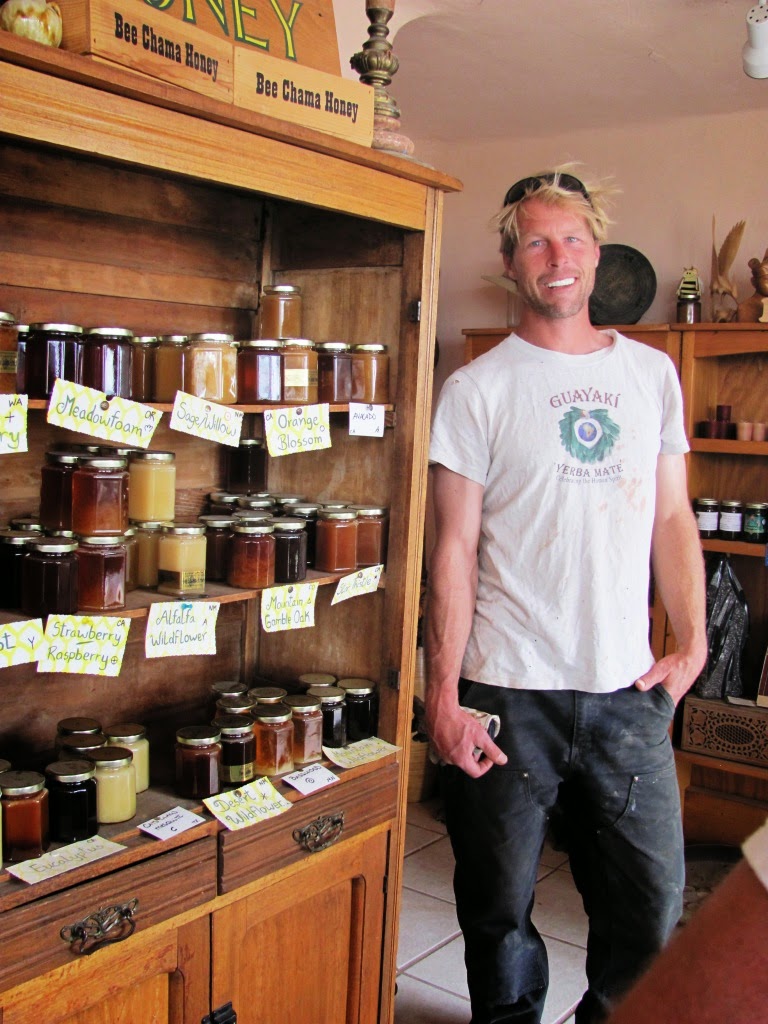
Arik and a variety of honey
Think all honey is the same? A glance at the honey I picked up at Bee Chama Honey shows otherwise. The strawberry/raspberry is a dark amber, the wild blackberry a few shades lighter. The cat’s claw/mesquite is pale, creamy, and opaque. The source of the flower nectar makes the difference. And bees make the honey.

Bee Chama Honey in Polvadera, just off I-25 in central New Mexico, is a sprawling complex of straw bale buildings and animal pens. I stop by with a group of friends after hiking. We cluster around the tasting table, which holds two dozen jars of honey in different flavors. By the time we’re done, everyone has picked at least one type to take home.

“The Middle Rio Grande is good for bees,” says founder Arik Glesne. “We just pay attention to what’s blooming when, and move the bees to control the floral source.” Some of their honey is local, and some of it is traded from other regions, which allows for the wide variety. “We really look for unique flavors.” Arik’s favorite is the mountain gambel oak. The bees use the honeydew off of leaves, instead of nectar from flowers.

Tasting honey
They also sell beeswax and bee pollen. Beeswax, used by the bees to make their honeycombs, can be made into candles. Bee pollen is a traditional medicine said to have many positive effects, including reducing allergies.

Bee Chama Honey has a farm store with observation hives and you-pick salad. They have some sheep for wool and may set up a demonstration loom. They also raise heirloom pigs for meat. They sell in Santa Fe.


Kris Bock writes novels of suspense and romance involving outdoor adventures and Southwestern landscapes. In Counterfeits, stolen Rembrandt paintings bring danger to a small New Mexico town. Whispers in the Dark features archaeology and intrigue among ancient Southwest ruins. What We Found is a mystery with strong romantic elements about a young woman who finds a murder victim in the woods. The Mad Monk’s Treasure follows the hunt for a long-lost treasure in the New Mexico desert. In The Dead Man’s Treasure, estranged relatives compete to reach a buried treasure by following a series of complex clues. Read excerpts at www.krisbock.com or visit her Amazon page. 

Monday, June 15, 2015

Review: Outlaws & Outcasts: The Lost Cemetery of Las Vegas, NM

I’ve been researching lost and buried treasures as I plot the next book in my treasure hunting romantic adventure series. (Click on the Reviews label for my reviews of treasure hunting tales.) Most southwestern treasure stories involve people searching for a known treasure that has been lost. This book is something different – an unknown cemetery was accidentally and unexpectedly found. The items may only be considered treasure to archaeologists, but it's still fascinating to think about what else might be hidden under seemingly empty land.

Outlaws & Outcasts: The Lost Cemetery of Las Vegas, New Mexico
by Ellen S. Rippel
Paperback: 78 pages
Publisher: East Salt River Press (2013)
ISBN-13: 978-0615899060

Book Description: Outlaws and Outcasts. They lay undisturbed and forgotten for almost a century--until a backhoe driver digging for gravel made a gruesome discovery. A hastily-assembled group of students, guided by an intellectually curious professor, had only one week to document the unearthing of the large, 19th century graveyard. Who was buried in those unmarked graves? What had they done to be cast out from society?

Filled with stories of early outlaws and fascinating historical insights, Outlaws and Outcasts chronicles a spellbinding and little-known saga from New Mexico. For those who love history, archaeology, or quirky stories from the Land of Enchantment, this book is an intriguing summary of what occurred in Las Vegas, New Mexico in 1972. Outlaws and Outcasts: The Lost Cemetery of Las Vegas, New Mexico recounts the accidental unearthing of graves in a gravel pit. Included in the narrative are examinations of historical burial practices and customs, and a search through the scarce literature on events specific to the existence of the cemetery.


The area where the cemetery was found
Review: This is a well-written and enjoyable account of an unusual piece of New Mexico history. In many ways, it raises more questions than it answers, as we have no way to know for sure who the dead are or why they were buried there. But pondering the question is great fun. The lively anecdotes and fascinating facts about burial practices, archaeology techniques, and local customs add to the charm. Whether you enjoy Southwest history, spooky tales, quirky facts, or just good storytelling, this book does the job. Black-and-white photos of some of the uncovered objects make the stories that much more real.


Kris Bock writes novels of suspense and romance with outdoor adventures and Southwestern landscapes. The Mad Monk’s Treasure follows the hunt for a long-lost treasure in the New Mexico desert. Whispers in the Dark features archaeology and intrigue among ancient Southwest ruins. What We Found is a mystery with strong romantic elements about a young woman who finds a murder victim in the woods. In Counterfeits, stolen Rembrandt paintings bring danger to a small New Mexico town. Read excerpts at www.krisbock.com or visit her Amazon page. 

Monday, June 8, 2015

Green Chile Stew

New Mexico green chile, 
Creative Commons License
I write novels of adventure and romance set in the Southwestern United States. The novels touch on local culture, including food. For my most recent romantic suspense, The Dead Man’s Treasure, I put together a recipe booklet of foods mentioned in the book, including this wonderful stew, great for groups, because everyone gets to adapt their own bowl to their own taste.

I called this "Camie's Green Chile Stew" because Camie is a character in the treasure hunting series, and the recipe is from my friend Alan, who partially inspired her character. 


Camie’s Green Chile Stew

2 medium onions
1 Tbsp. garlic
2 Tbsp. oil
1 pound ground beef or cubed stew beef
Chopped green chile to taste, about 1/4 to 1/2 cup (you might find be able to find canned green chile in the Mexican section of your grocery store)
4 cups chicken broth
salt and pepper to taste

Serve with any or all of: 

canned pinto beans or black beans; 
cubed, cooked potatoes; 
hominy; 
shredded cheddar or Jack cheese; 
shredded lettuce, chopped tomatoes, cilantro; 
extra green chile; 
chopped avocados or guacamole; 
sour cream

  1. Sauté onions and garlic in oil until golden.
  2. Add beef and stir until browned.
  3. Add chopped green chile and chicken broth. Bring to a simmer. Salt and pepper to taste.
You can use it immediately, but it’s even better if it cooks for a few hours on low heat.

  1. Put the beans, hominy, cheese, etc. into individual bowls. Let people build their own blend of chili. Add ingredients such as beans, potatoes, and cheese, and heat each bowl in the microwave. Then add cold ingredients such as sour cream and avocado.


Rebecca Westin is shocked to learn the grandfather she never knew has left her a bona fide buried treasure – but only if she can decipher a complex series of clues leading to it. The hunt would be challenging enough without interference from her half-siblings, who are determined to find the treasure first and keep it for themselves. Good thing Rebecca has recruited some help.

Sam is determined to show Rebecca that a desert adventure can be sexy and fun. But there’s a treacherous wildcard in the mix, a man willing to do anything to get that treasure – and revenge.

Action and romance combine in this lively Southwestern adventure, complete with riddles the reader is invited to solve to identify historical and cultural sites around New Mexico. See the DMT page of Kris Bock’s website for a printable list of the clues and recipes from the book.


The first book in the Southwest Treasure Hunters series is The Mad Monk’s Treasure. The Dead Man’s Treasure is book 2. Each novel stands alone and is complete, with no cliffhangers. This series mixes action and adventure with “closed door” romance. The stories explore the Southwest, especially New Mexico.

Monday, June 1, 2015

Socorro, New Mexico: Climbing Grows Up

A climber in Box Canyon
(Adapted from an article originally published in enchantment magazine by NMRECA.)

In my last post, I described some of the excellent rock climbing around Socorro, in central New Mexico. No doubt people have been scrambling on rocks in this area for centuries. Rock climbing as a sport grew out of mountaineering and developed as an independent sport in the 1950s.

People may have been rock climbing in the Socorro area for that long, and certainly have been developing climbing routes since the mid-1970s. A climber who started in 1980 remembered when trad climbing was the only option. Climbers had to wedge specially designed tools into holes and cracks in the rock – if they could find a suitable place. “We’d tie ourselves on a rope and climb some climb, and find there wasn’t any place for protection,” the climber said. “I’d use up my strength and think, I better finish this climb, or climb down.”

Alan Erickson at Spook Canyon
In 1983, the late Bertrand Gramont, “a climbing fanatic” famous for his strength and colorful spandex leggings, arrived from France. He started setting climbs by drilling permanent metal bolts into the rock, adding safety. By the mid-1980s, Box Canyon had dozens of established climbing routes, and climbers were exploring surrounding areas.

Alan Erickson took the rock climbing class from Gramont in 1986. “He had too many students for his taste,” Alan says. “So one of our first exercises was to rappel down from the highest and most exposed peak in Box Canyon, then climb back up on one rope while dragging another, while traversing over a cave. Three-quarters of the class never showed up again. I, on the other hand, ended up dedicating my early would-be-academic career to climbing!”

VLA employee Bob Broilo took the rock climbing class in 1989. “The instructor noticed my impatience while I was waiting for a turn at either climbing or belaying. He sent me and some of the more adventurous students over to the Ultimate Boulder. The rock was so solid, the moves so powerful, and the convenience so seductive that I started bouldering at Box in earnest.”

Bob Broilo bouldering at Streambed in Box
Dancing with Rock

The lure of the rock now draws in today’s young climbers. “I fell in love with rock climbing,” said a student at the local New Mexico Tech university. “It is such a great rush, but not a super fast sport. Plus, the rock out here is super amazing.”

Despite the large number of college students climbing around Socorro, climbing isn’t just a young man’s sport. You may meet families with young children, middle-aged mothers, and weekend warriors going gray. Regardless of age, the main goal is to have fun.

“My favorite climbing achievements have always been those in which I feel like I’m flowing up the rock like syrup dripping over pancakes,” Alan says. “Each motion flowing from the last, each movement slow and controlled. Getting to the top? Very hard climbs? Not priorities for me. I like to dance with rock.”

Phil Miller sets up a climb from the top of a cliff
For many climbers, part of the fun is learning to do something different and challenging. According to New Mexico Bureau of Geology employee Phil Miller, “Even if it’s an easy problem, I know that not everyone can do that, or wants to. I also like the puzzle – setting up and cleaning [removing gear], any of the technical parts of the climb. No one can just tell me how to do it. I have to figure it out, then convince my body to do it.”

Tech graduate Zeb Westrom noted, “You don’t just normally walk up the side of a rock. It takes skill, and you have to learn.” Climbs are given a number rating for difficulty, which appeals to goal-oriented climbers. “It’s sort of like leveling up in gaming, improving yourself.”

Whether you want to compete against yourself or simply lounge in the sun with your friends, nothing beats the thrill of the outdoors, or the feel of dancing with rock.


More on the Box Canyon climbing area, including a link to download the Box Canyon: Enchantment Tower’s Socorro Climbing Area Guide. 


Kris Bock writes novels of suspense and romance involving outdoor adventures and Southwestern landscapes. In Counterfeits, stolen Rembrandt paintings bring danger to a small New Mexico town. Whispers in the Dark features archaeology and intrigue among ancient Southwest ruins. What We Found is a mystery with strong romantic elements about a young woman who finds a murder victim in the woods. The Mad Monk’s Treasure follows the hunt for a long-lost treasure in the New Mexico desert. In The Dead Man’s Treasure, estranged relatives compete to reach a buried treasure by following a series of complex clues. Read excerpts at www.krisbock.com or visit her Amazon page. 

Monday, May 25, 2015

Socorro, New Mexico: Rock Climbing Heaven

Phil Miller on "Nasty Sally."
(Originally published in Published in the enchantment magazine by NMRECA.)

Phil Miller is standing 15 feet up a rock cliff, one foot on a four-inch ledge, the other pressed against a sloped face.

He wedges the fingertips of his left hand in a tiny crack, and leans to the right. In one smooth move, he straightens his left arm, pushes against the sloping rock with his left foot, and reaches high with his right hand. His right foot floats in space until he tucks it up on a rocky protrusion. He is at the crux – the hardest move – on the climb called Nasty Sally.

Phil grunts, pushes off, stretches high. His hand brushes the next hold, barely within his reach. His fingers tighten. His grip slips.

He falls.

A moment later he is hanging in his climbing harness, groaning, then laughing. His belayer smiles up at him and says, “Nice try.” Nasty Sally has won again. But there’s always next time.

Nasty Sally is Phil’s “love to hate” climb, the best kind. “I know I can do them, but they are going to be a challenge the whole way through,” he explains. He has already made Nasty Sally “clean” – without falling or hanging on the rope – but can't yet do it every time.

Phil provides a safety check for Tammy
Phil started climbing as a student at New Mexico Tech. Many Tech students take advantage of climbing classes to get out of the classroom and into the sun. Others learn informally, from friends. Either way, the stress relief of climbing is welcome.

Biology student Tammy tried climbing after watching friends. “Everybody’s friendly,” she says, “You may have never seen them before, but everyone’s welcome.” Her favorite part is being able to accomplish something new. “Rather than being competitive, if you get to the top it’s because you did it.”

Climbing comes in many varieties. Top-roping is the safest. The rope hangs from an anchor, so a climber can’t fall more than a few feet. In lead climbing, a climber clips a rope to bolts drilled into the rock every 5 to 15 feet on the way up. If a rock face has no permanent bolts, a trad climber can wedge special equipment into cracks and pockets to provide protection. All these are forms of rope climbing, which requires a few hundred dollars worth of equipment, and a partner for the belay – someone to anchor the other end of the rope and control falls, aided by braking equipment.

A group of boulderers at Streambed in Box Canyon.
Some climbers prefer bouldering, which can be done solo with no more than a pair of climbing shoes. A bouldering “problem” involves a short sequence of moves up a boulder or across a rock wall. Because they stay close to the ground, boulderers don’t need ropes, though most like a bouldering pad to cushion falls.

Problems, Problems Everywhere

Socorro is a haven for climbers of all types, with around 100 set climbing routes and over 700 boulder problems within 10 miles of town. Most of these are in Box Canyon and Spook Canyon, which lie side by side off Route 60, about 7 miles west of Socorro. The Box and Spook Canyon areas are BLM land, specially designated for climbing and bouldering. Local climbers have a long and friendly history with the BLM. “Climbers are often BLM’s eyes and ears by reporting problems,” said a BLM Outdoor Recreation Planner. “As volunteers they clean up the area and help with projects.”

Climbing a crack at Spook Canyon
The canyons’ rocks provide interesting variety for all abilities: fine-grained, smooth planes with tiny cracks and ledges for fingers and toes; rough surfaces perfect for smearing (pressing a foot against flat rock to create friction); or big bulges and huecos (pockets) for easy holds.

The warm, dry Socorro weather allows climbing year-round. Winter sees many day visitors from Albuquerque and Santa Fe. School breaks bring vans of young people from as far as Canada to camp at Box Canyon.

Despite these far-flung visitors, the area is rarely crowded. Waterfall Wall, just off the parking lot, is sometimes strewn with colorful ropes over many of the 16 climbs. This is a favorite spot because climbers can hike around the cliff and drop ropes from bolted anchors, for safe and easy setup. Nearby Dirt Wall and Hueco Wall are also popular, with climbs ranging from very easy to nearly impossible, and the added winter advantage of direct sun all afternoon.

But walk north down the streambed a few hundred feet, and you’ll find other climbing areas and fewer people. Or take the easternmost dirt road south a mile, to more climbing walls, plus a large boulder field. Spook Canyon’s two east facing walls are lesser known, not even listed in most climbing guides. With so many choices, you’ll always find great climbs open.

Author Kris Bock at The Enchanted Tower area
Heat and bugs make summer less ideal. Devoted climbers head out early in the morning, or after dark – VLA employee Bob Broilo frequently sponsors “night missions” for boulderers, with battery-powered lights. Another option is The Enchanted Tower, just 75 minutes east on I-60 and cooler at over 7000 feet elevation. This spectacular climbing area was developed by Socorro climbers in the 1980s and remains a favorite escape from summer heat.

Other popular climbing areas are scattered across New Mexico, but Socorro remains a favorite for the number of good climbs and ease of access.

For Phil, the best part of climbing is that, “The world falls away.” A boulder problem may last only 45 seconds, but, “For those 45 seconds, nothing else is in my mind. The stresses of daily life all go away.”


More on the Box Canyon climbing area, including a link to download the Box Canyon: Enchantment Tower’s Socorro Climbing Area Guide. 

Next week, part two will include some of the history of climbing in Socorro.


Kris Bock writes novels of suspense and romance involving outdoor adventures and Southwestern landscapes. In Counterfeits, stolen Rembrandt paintings bring danger to a small New Mexico town. Whispers in the Dark features archaeology and intrigue among ancient Southwest ruins. What We Found is a mystery with strong romantic elements about a young woman who finds a murder victim in the woods. The Mad Monk’s Treasure follows the hunt for a long-lost treasure in the New Mexico desert. In The Dead Man’s Treasure, estranged relatives compete to reach a buried treasure by following a series of complex clues. Read excerpts at www.krisbock.com or visit her Amazon page. 

Monday, May 18, 2015

The Lost Cemetery of Las Vegas, New Mexico, with Ellen Rippel

Coffin handle from infant’s grave.
In April I did a guest column for Southwest Armchair Traveler and mentioned my search for “grounded” topics.  These pursuits have led to my involvement in diverse subjects, the most important of which was documenting the 1972 discovery of a century-old lost cemetery in Las Vegas, New Mexico. The Southwest is filled with fascinating, old graveyards but this particular one was, and still is, very special to me.

In October of 2013 I wrote Outlaws & Outcasts: The Lost Cemetery of Las Vegas, New Mexico.  A re-write of my 1979 history thesis from N.M. Highlands University, it was something I had put off doing for over 30 years. (I was good at procrastination, and had successfully raised it to an art form.) Here’s an excerpt from the book, recounting when the graveyard was first discovered by a backhoe operator in 1972:

The quarrying got underway right after Labor Day. The driver of a large backhoe began removing the grasses and top layer of soil, revealing the stone that he would soon crush into gravel. He glanced down while he was working, and something caught his eye. He looked more closely at the area he had begun to clear. 

The surface was sprinkled with bones, coffin fragments, and what appeared to be parts of a human skull – unmistakably all items associated with a burial. He guessed from the deteriorated condition of the objects that the grave was not a recent one.... The driver climbed down from the backhoe to get a closer look. He realized he was seeing the contents of not just one grave, but several graves.

Thus began the mystery of the Lost Cemetery of Las Vegas, New Mexico.
This is what the area around the quarry site probably looked like in 1972 –
hilly terrain, pinon trees, and lots of rock, but no hint of a cemetery.

The paupers’ cemetery in Las Vegas, NM was of particular interest to historians because it was known to have included famous outlaws – hanged or shot by lawmen and vigilantes during the early railroad days in the late nineteenth century.  But the exact location of “Boot Hill” became forgotten over time.  When the graveyard was accidently uncovered in 1972 only a small portion of it was archaeologically retrieved. Seventeen bodies were found, but conceivably as many as 25 or more additional bodies were needlessly destroyed.  And with that destruction, a large part of Southwest history was forever lost.  

Desecration of cemeteries, not just in New Mexico, but throughout the U.S., is not uncommon.  Sometimes folks who lived close to a cemetery – maybe a non-active one, maybe one that held people with different beliefs than theirs – would take a headstone and use it for a step in front of a doorway. This pilferage (and the fact that grave markers in a paupers’ lot were often handmade of wood scraps) makes it understandable how a cemetery might disappear in a brief period. 

Celluloid collar and silk tie from one of the better-preserved graves.
A major motivator for writing Outlaws & Outcasts was when I discovered the forgotten cemetery was the pauper’s graveyard dating back to the 1800s. The people buried there had been discounted as being poor, disreputable or insignificant. What troubled me was that an infant’s grave was one of the 17 uncovered.  I wondered what a baby might have done to justify that kind of oblivion. At least now I can rest easy knowing that my book – recounting the facts of the discovery of the Lost Cemetery of Las Vegas – will help assure the people buried there are not forgotten, and that one of the mysteries of the Southwest has been solved.


Ellen Rippel is the author of Outlaws & Outcasts:  The Lost Cemetery of Las Vegas, New Mexico. For those who love history, archaeology, or quirky stories from the Land of Enchantment, the book is an intriguing summary of the unearthing of an unknown century-old graveyard in Las Vegas, New Mexico in 1972. Outlaws & Outcasts is filled with stories of early outlaws and fascinating historical insights, including examinations of historical burial practices and customs, and a search through the scarce literature on events specific to the existence of the cemetery. 

Monday, April 27, 2015

Review: Western Treasure Tales by Choral Pepper

I’ve been researching lost and buried treasures as I plot the next book in my treasure hunting romantic adventure series. The first book in the Southwest Treasure Hunters series is The Mad Monk’s Treasure. The Dead Man’s Treasure is book 2. Each novel stands alone and is complete, with no cliffhangers. This series mixes action and adventure with "closed door" romance. The stories explore the Southwest, especially New Mexico.

Western Treasure Tales
Choral Pepper
Publisher: Univ Pr of Colorado, 1998
Pages: 130
ISBN-13: 978-0870814891
Paperback: under $10 used

The Jameson books I've reviewed have generally had dozens of treasures listed, told in the voice of an outside storyteller. Choral Pepper’s book is more personal. She describes only eight adventures, but she goes into them at length. In most, she recounts some personal experience seeking the treasure.

The eight stories cover seven states: Arizona, Colorado, Utah, Nevada, Oregon, and New Mexico (twice). One tale shares the curious tale of the three men named Pegleg Smith who each found black gold – not oil, but gold with a small amount of copper which oxidizes to turn the nuggets black.

Another story covers the search for an Aztec treasure, known as Montezuma's Treasure. Was the Aztec homeland really in Utah, perhaps on an island in the Great Salt Lake? Historians make a case for that. However, it is less certain that Aztecs carried their treasure back north in order to protect it from Spanish invaders. Still, an entire town joined in the hunt. (Spoiler: They failed to find the treasure.)

The author's imagination adds to the stories. When hunting Montezuma's Treasure, she writes, "I sat on the edge of the rock-strewn ravine below the cave and imagined an endless file of Aztec tamenes clothed in loincloths, stooped under fifty-pound loads of gold in leather bags supported against their backs as they plodded through the valley below. Marsh grass then would have curled against the gentle wind and the guttural commands of Aztec cacique guards, their jeweled and feathered helmets glittering in sunlight, would have echoed up to where I sat."

She also assumes thoughts and feelings for some of the historical subjects, as in, "Tossing restlessly on his palette, Lebreau thanked the good Lord he had secreted most of the gold…. In his mind's eye he reviewed once again his map…." Pierre Lebreau did write about his frustrating and devastating travels – he was the only one of his large French contingent to survive and the treasure remains hidden in Colorado. However, it's likely Pepper took some artistic liberty in recounting the history.

Sometimes Pepper’s more recent personal tales are as fascinating as the old legends. She joined Erle Stanley Gardner, author of the popular Perry Mason mysteries, on a treasure hunt in the Oregon desert. Who wouldn't want to be in on that camping trip?

This is an entertaining book, both for the historical legends and the insight into a mid-20th century treasure hunter. It even includes a translation of Spanish directions to a great treasure possibly hidden in Tumacacori, Arizona, should the reader wish to brave "one of the roughest, most cut-up regions in North America."

Photos from Choral Pepper’s adventures, some with Erle Stanley Gardner

This online issue of Desert Magazine, from when Pepper was the editor, contains the story of her adventure in Baja California on a blimp along with Gardner. And here's another of Pepper’s Baja stories with Gardner. The text is very faint and hard to read online, but I was able to select, copy, and paste it into a text box for easier reading.


Kris Bock writes novels of suspense and romance with outdoor adventures and Southwestern landscapes. The Mad Monk’s Treasure follows the hunt for a long-lost treasure in the New Mexico desert. In The Dead Man’s Treasure, estranged relatives compete to reach a buried treasure by following a series of complex clues. In The Skeleton Canyon Treasure, sparks fly when reader favorites Camie and Tiger help a mysterious man track down his missing uncle. Whispers in the Dark features archaeology and intrigue among ancient Southwest ruins. What We Found is a mystery with strong romantic elements about a young woman who finds a murder victim in the woods. In Counterfeits, stolen Rembrandt paintings bring danger to a small New Mexico town. Read excerpts at www.krisbock.com or visit her Amazon page. 

Monday, April 20, 2015

The Deming Rockhound Roundup, with Ellen Rippel

Decades ago an astrologer studied my natal chart and observed that it was utterly devoid of earth. She told me I had to find ways to “get grounded” to balance out my other elements: air, fire and water. So I began a quest for “earthy” endeavors, and, happily, New Mexico has been the ideal place for me to contemplate subjects like archaeology, paleontology, cemeteries, pottery, rock hounding and rock collecting. 

A favorite rock-related pursuit for me has been attending the annual Rockhound Roundup, celebrating its 50th anniversary earlier this year. Sponsored by the Deming Gem and Mineral Society (DGMS), the Roundup is held on several acres at the Southwestern New Mexico State Fair Grounds in Deming. With free admission, free parking, over 100 indoor and outdoor vendors, and near-perfect weather, it’s easy to see why thousands of visitors attend the four-day show.

One of the more popular areas at the Roundup is the geode-cutting booth. Geodes are volcanic, spherical (usually) hollow rocks, and many contain multi-colored crystals in their interiors. The regions around Deming, with dormant volcanoes silhouetting the four compass points, are peppered with thousands of geodes.  There’s a genuine sense of treasure-hunting involved in trying to choose the “right” geode (on the outside they’re bumpy and drab) from a box of 40 or 50, and then watching it be cut open, exposing material formed eons ago. 

In addition to other events, the DGMS also schedules two auctions during the show, one of them silent.  The “silent” auction tends to be just the opposite – exceptionally noisy – with over 100 people darting around long tables covered with varying sizes and qualities of rocks. Every piece being auctioned has paper and pen nearby so participants can write down a bid in list format. Each bid must be an increase over the previous one. Normally participants move around the tables quickly, bidding on numerous items. The process reminds me a little of musical chairs – minus the chairs and music. If, for some reason, you’ve found the rock of your dreams and don’t want to lose it, you stand your ground right next to it, glaring at anyone who attempts to outbid you.  After a few minutes of controlled chaos an official shouts, “Time’s up!”  The results are tallied and a new round begins. 

Events aside, my favorite activity at the Rockhound Roundup is simply walking around, absorbing the ambiance, and talking with enthusiastic vendors and other rock collectors. It gives me that “grounded” feeling I was told to grab on to many years ago. Purchasing a few more rocks to add to my collection doesn’t hurt either.

For more information about the annual Rockhound Roundup visit the Deming Gem and Mineral Society:

Ellen Rippel is the author of Outlaws & Outcasts:  The Lost Cemetery of Las Vegas, New Mexico. For those who love history, archaeology, or quirky stories from the Land of Enchantment, the book is an intriguing summary of the unearthing of an unknown century-old graveyard in Las Vegas, New Mexico in 1972. Outlaws & Outcasts is filled with stories of early outlaws and fascinating historical insights, including discussion of historical burial practices and customs, and a search through the scarce literature on events specific to the existence of the cemetery.

Monday, April 6, 2015

Jemez Springs, New Mexico, Sites

On 3/16, I described the Hot Springs around Jemez Springs, New Mexico. The town and the surrounding area has more to offer than simply soaking. You can also visit the ruins of an old Spanish church; Soda Dam, a cool rock formation formed from the mineralized water flowing in the river; and Battleship Rock, so named because it resembles the prow of a battleship. (Pictures on my Pinterest page.)

I’ve attended many writing retreats at a Hummingbird Music Camp north of the town, and those experiences inspired my romantic suspense novel Counterfeits. When Jenny inherits a children’s art camp, she discovers that her grandmother’s death might not have been an accident after all. Doing research at a real camp tucked away in the woods, and hiking above Battleship Rock for a scene where Jenny gets lost, helped the setting feel realistic. Here's an excerpt from when Jenny visits Battleship Rock.

She stood for a minute on the short bridge over the narrow river, watching the water bubbling over rocks. The sound was like music in the quiet air. She listened carefully but could hear no human noises except for, occasionally, the faint hiss of a car passing on the highway. The lazy insects buzzing in the bushes were louder.
Something unwound inside her, some tension she hadn’t even known she held. She had gotten used to the noise and bustle of the city – she’d thought. If asked, she might have expected the quiet and loneliness here to be difficult to bear. But it wasn’t. It was peaceful.
She retrieved her painting equipment, leaving her purse tucked underneath the front seat. It seemed silly to lock the car with no one around, but she did it anyway. She passed under the shadowy trees and set up with a clear view of Battleship Rock, the 200-foot-tall cliff that got its name because it looked like the prow of a ship, at least to some imaginative people.
At the base of the cliff, the slope continued at a gentler angle, covered with small boulders and jumbled loose rocks that made for awkward footing. She didn’t need to get that close anyway. Perched at the border between the trees and the boulder field, she had sunshine and a clear view.

Of course, in the book, the site doesn't stay so relaxing. The men who killed her grandmother are searching for stolen paintings, and they think Jenny is involved. They find her at Battleship Rock and she has to escape up the steep trail into the woods:

Her boots ate up the hard-packed dirt. She pushed past bushes and ducked under tree branches, panting as the slope got steeper. She scrambled over a series of fallen boulders, and then she was in the evergreen trees. Branches brushed her arms and caught at her hair as she plunged ahead.
Up, up, she surged. Her boots slipped in the loose dirt, dragging her back, forcing her to fight for every inch and use her hands for balance. Her lungs burned and her thighs screamed, but she kept moving. She made the forested plateau where the land flattened out and she was running, running, first through the most open path, but there they could see her, catch up with her, so she darted into thicker trees.
Her chest was on fire. She glanced back and didn’t see anyone. Hide, hide. She ducked behind a huge fallen log and tried to squat, but her legs gave out and she sat down hard. At least she was now hidden behind the nearly three-foot-high log.

Visiting real places can help a writer bring their setting to life. Book or web research has its place, but there's nothing like smelling the evergreen trees and feeling the burn in your thighs as you hike to help capture those sensory details!

Counterfeits: Painter Jenny Kinley has spent the last decade struggling in the New York art world. Her grandmother’s sudden death brings her home to New Mexico, but inheriting the children’s art camp her grandmother ran is more of a burden than a gift. How can she give up her lifelong dreams of showing her work in galleries and museums?

Rob Caruso, the camp cook and all-around handyman, would be happy to run the camp with Jenny. Dare he even dream of that, when his past holds dark secrets that he can never share? When Jenny’s father reappears after a decade-long absence, only Rob knows where he’s been and what danger he’s brought with him.

Jenny and Rob face midnight break-ins and make desperate escapes, but the biggest danger may come from the secrets that don’t want to stay buried. In the end, they must decide whether their dreams will bring them together or force them apart.