Monday, August 31, 2015

Adventures in Science

Pnina in Uganda
By Chris Eboch. First published in the enchantment magazine by NMRECA, March 2013

When many people think of New Mexico – if they think of it at all – they either think of Santa Fe/Taos artists, or they imagine the Wild West. But New Mexico also has a long history in the sciences. (Most famously, the atomic bomb was developed in Los Alamos and tested near Alamogordo.) That history continues at research labs and universities around the state, especially at the small but respected New Mexico Institute of Mining and Technology in Socorro.


Many people picture a certain stereotype when they hear the word “scientist” – male, antisocial, and stuck in a lab. Pnina Miller and Mouse Reusch of Socorro, New Mexico, counteract the cliché.

Both work at IRIS PASSCAL, the short name for The Incorporated Research Institutions for Seismology (IRIS) Program for Array Seismic Studies of the Continental Lithosphere (PASSCAL) Instrument Center at New Mexico Tech. In layperson terms, they work with scientists studying the interior of the Earth.

While in a PhD program, Pnina researched jobs and discovered PASSCAL. She got a job with the manufacturer of some of the equipment seismologists use to record earthquakes. “I knew I wanted to get to PASSCAL, and through the manufacturer was my path.” At PASSCAL, she says, “I could go into the field and do fun research and play with the equipment. It was absolutely perfect for me. I was born to do this.”

Mouse in Tan.zania
In 2007, she met Mouse, who says, “We were similarly scientifically inclined, similar age, similar interests, fun, loved field work, and I spent many, many hours asking her about PASSCAL.” Mouse came to PASSCAL at the first opportunity.

Despite their similarities, their jobs are different. “I do a little bit of almost everything,” Pnina says. “I go to the field and support our Principal Investigators (PIs) in their research, I do logistics, which means I schedule the equipment. I do a lot of training sessions now. I supervise the two warehouse guys and count inventory. My job has changed over the nine years I’ve been there, so now I’m more of a supervisory role. The last thing that I do, and the main thing that I used to do, is evaluate the sensors and test them on our seismic testing piers.”

“I do what she doesn’t,” Mouse says. “I’m in the data group, working with the researchers that Pnina trained to collect data. They’re required by National Science Foundation guidelines to make their data publicly available. I help them archive it in a consistent and standardized format. Then it becomes available for anyone in the world to use. The place that we work really does help further seismology around the world.”

“Our PIs study a lot of different things,” Pnina explains. “We deploy in different kind of places: volcanoes, glaciers, plains, rift valleys, mountainous regions.”

Mouse adds, “They study from the upper tens of meters of the crust, things that are very shallow subsurface, to things that extend to 3000 kilometers down to the mantle and core.” One group in Africa was studying elephants, trying to determine if their stomping was random or they were sending messages. Others study why earthquakes happen, trying to better gauge hazards. “For volcanoes, they’re usually studying the interior structure,” Pnina says. “They study changes in ice sheets, which can be tied to climate change. They study how glaciers move structurally.”

Working in Antarctica
A World of Work

To support this science, PASSCAL employees may travel around the world to install or maintain instruments. Pnina’s international travel destinations include Spain, Morocco, Antarctica, Tanzania, Uganda, Jordan, Canada, Costa Rica, and Venezuela. “Through all the places, the people I work with in geosciences are very excited about it and want to learn more,” she says. “The PIs are really fun and friendly. You do the work, but afterwards, there’s some opportunity to tour around.” She worked with a local man in Morocco. “He brought me to his house with his family and we had a big dinner after a long field day. You get to see things tourist don’t necessarily get to see.”

With PASSCAL, Mouse has been to Antarctica and Botswana. For other seismic experiments, she’s been to Cameroon, Tanzania, South Africa, and Chile. “I enjoy the adventure, meeting new people, trying new foods, new cultures, frequent-flier mile status,” she says.

Understanding the Earth

Besides the excitement of travel, Mouse notes the value of the work itself. She worked on a project in Chile one month after the big 2010 earthquake. “A lot of the science that I did in grad school seemed kind of esoteric. Why do you care about the mantle structure beneath Cameroon, West Africa? But this was recording aftershocks. We were in Concepción, where the 15-story building had fallen over, the bridges were damaged, and people were displaced. It felt very meaningful, worthwhile, a reassurance of the importance of the work we do. We are contributing to this great body of knowledge and understanding of the Earth.”

Pnina advises young scientists, “If there’s something you want to explore, head in that direction. You never know what you might discover.”

Mouse adds, “There are so many mysteries out there, in the ground, above the ground, in the water, in space. You need imagination and curiosity. I have fun nearly every day.”


As these women prove, science doesn’t just take place in a lab, so there are opportunities for the most adventurous spirit.

Monday, August 24, 2015

Western History Mysteries


Author Earl Staggs has started a series of articles called “History’s Rich With Mysteries” at Kevin’s Corner (“Book Reviews and More”). These might be of interest to fans of Southwest travel and history:


The Mystery of Billy the Kid – “While some facts about Billy the Kid’s life are known, much about him is supposition, exaggeration, myth, and tales told around a campfire, leaving us with a number of mysteries surrounding his life and death. …”

Who Was Etta Place? – “She has come down to us through history as the best known female outlaw of that period and some say, the most beautiful. And the most mysterious. No one is certain where she came from before she hooked up with Butch and Sundance ….”

Author Rabbi Ilene Schneider wrote about “The Life and Legend of Josephine Sarah Marcus Earp – “Many years ago, read that Wyatt Earp’s wife was Jewish. … Okay, so the supposed “facts” of her birth are, at best, murky. But it is known that her parents were Jewish immigrants from Prussia….”

And from author J. Michael Orenduff, and entertaining, more recent true story from Mogollon, New Mexico: The Legend of Burro Joe – “Was Burro Joe a brilliant scientist or a man on the run after murdering his wife? J. Michael Orenduff recalls his encounter with the mysterious recluse.”

Wednesday, August 12, 2015

Southwestern Romantic Suspense on Sale

Whispers in the Dark is on sale for $.99!

Reviewers give it a 4.3 star average: “A great read with a strong plot line & likeable characters!” 

Whispers in the Dark: 

Archaeology student Kylie Hafford craves adventure when she heads to the remote Puebloan ruins of Lost Valley, Colorado, to excavate. Romance isn’t in her plans, but she soon meets two sexy men: Danesh looks like a warrior from the Pueblo’s ancient past, and Sean is a charming, playful tourist. The summer heats up as Kylie uncovers mysteries, secrets, and terrors in the dark. She’ll need all her strength and wits to survive—and to save the man she’s come to love. 

Whispers in the Dark, romantic suspense set in the Four Corners region of the Southwest, will appeal to fans of Mary Stewart, Barbara Michaels, and Terry Odell. Get your copy today!

Buy or sample on Amazon

The Mad Monk’s Treasure e-book is also on sale for $.99! 

Reviewers give it a 4.4 star average: “Great balance of history, romance, and adventure. Smart romance with an "Indiana Jones" feel. Well-written with an attention to detail that allowed me to picture exactly in my head how a scene looked and played out.” - Jules R.

A heretic Spanish priest’s gold mine, made richer by the spoils of bandits and an Apache raider—the lost Victorio Peak treasure is the stuff of legends.

When Erin, a quiet history professor, uncovers a clue that may pinpoint the lost treasure cave, she prepares for adventure. But when a hit and run driver nearly kills her, she realizes she’s not the only one after the treasure. And is Drew, the handsome helicopter pilot who found her bleeding in a ditch, really a hero, or one of the enemy? Just how far will Erin go to find the treasure and discover what she’s really made of?

“The story has it all - action, romance, danger, intrigue, lost treasure, not to mention a sizzling relationship....”

Get it now from Amazon, Barnes & Noble, All Romance E-Books, Kobo, or Apple/iTunes:

Monday, August 3, 2015

Window to the Wild: Working with Falcons and Hawks

Ready to hunt pigeons
Two weeks ago I shared the experience of going on a “hunt” with falconer Matt Mitchell, and last week I talked about raising falcon and hawk chicks. Here’s part three of the series.

There are 70-80 falconers in New Mexico, and a few thousand falconers in the United States, most with only one or two birds. The sport requires education and dedication, and is expensive, with food, veterinary bills, and the cost of gas for daily hunting trips.

During hunting season, Matt is out with his birds twice most days. He has two falcons and a Harris hawk on his falconry hunting permit. (The other 10 birds are on a breeding permit.) “I take the two falcons out in the morning, usually before sunrise,” he says. “I’m out looking at ponds, and I get those after ducks. If I don’t find anything to hunt with the birds I take homing pigeons out.”

Homing pigeons are a challenging quarry – usually too challenging to kill, but they give the falcons a workout before flying home. “Taking a pigeon out of the bag and throwing it isn’t falconry,” Matt claims. “It’s just a training technique.” True falconry involves a trained bird hunting wild prey in nature. “But if I haven’t found anything to hunt, the pigeons give it a workout. Then in the afternoon, after work, I’ll take the Harris hawk out and fly that for an hour or so, chasing rabbits.”

It’s possible to lose a bird if it heads after distant game or decides to try migrating. Falconers use radio telemetry to track the birds, but sometimes the telemetry breaks or comes off. In other cases, it may be impossible to reach the bird. Matt had one that went into White Sands territory, and he wasn’t allowed to go after it. “I went out every day and tried to get the signal and hoped it would come off but I never got it back,” Matt says. “But a year later, the Audubon people at the Bosque del Apache saw a peregrine flying around down there with a telemetry unit on its leg. I like to think it’s mine, but for all I know it could’ve been some guy’s bird from Montana.”

Losing a bird is a reminder that these are not pets. “They’re really wild creatures that have allowed you to hunt with them,” Matt says. If the bird was raised properly, it should be able to survive on its own. Falconers have been known to get calls that their bird has been found nesting halfway across the country.

Birds can also die in accidents or animal attacks. “All the laws of the wild apply,” Matt says. “If something ever happens to them you’re heartbroken. With that in mind, you take your little warriors out every day and hope for the best.”

The chance to share a falcon or hawk’s life is worth the challenges. “In ideal conditions, you are basically seeing the bird’s natural behavior all the way,” Matt says. “With trained raptors, it’s a window onto what these birds do in the wild every day.”

This was excerpted from an article first published in the enchantment magazine by NMRECA, July 2012

What We Found is a mystery with romantic elements about a young woman who finds a murder victim in the woods. It features falconry as a subplot.

Kris Bock writes novels of suspense and romance involving outdoor adventures and Southwestern landscapes. In Counterfeits, stolen Rembrandt paintings bring danger to a small New Mexico town. Whispers in the Dark features archaeology and intrigue among ancient Southwest ruins. The Mad Monk’s Treasure follows the hunt for a long-lost treasure in the New Mexico desert. In The Dead Man’s Treasure, estranged relatives compete to reach a buried treasure by following a series of complex clues. Read excerpts at www.krisbock.com or visit her Amazon page. 


Monday, July 27, 2015

Falcons, Hawks, and Wildlife Rescue

Last week I shared the experience of going on a “hunt” with falconer Matt Mitchell. Now here's insight into the life of someone who works with birds of prey.

Matt has always loved animals. When he was a teenager living in Albuquerque, a neighbor had a Swainson’s hawk. “I thought that was the coolest thing,” Matt says. He did the necessary training and apprenticeship, eventually working up to a master falconry license, and at the time of this writing had 13 birds.

Matt also nurses birds that have been injured by hunters or in accidents. He says, “Having birds, people started bringing me injured birds, and of course you have to be covered by a permit, so I joined wildlife rescue. Most hunters now tend to be more conscientious, but I still get injured birds in every year.”

Matt considers education the most important part of wildlife rescue. He talks to school children and other groups, letting people see the beauty of falcons and hawks. This kind of education “gives wildlife value, because it says somebody cares.”

Falconers play an active role in conservation, working with environmental groups on projects such as protecting habitat. “The biggest threat to falconry today is loss of habitat,” Matt says. “Falconers are very aware of keeping places wild, keeping lots of birds and bird breeding habitat protected. We’d like to see the sky full of birds.”

He sometimes gets birds passed along by well-meaning but inexperienced people who have tried to raise a wild chick or injured bird. The bird has almost always suffered from poor care. People must have a permit to keep falcons, and getting one requires a two-year apprenticeship and inspection of facilities. Matt’s facilities include two stucco buildings, each with separate 8x8 rooms for individual birds, plus a large, net-covered flight pen.

Chicks at 3 weeks and 2 days
“Falconry is an addiction in a way,” Matt says. “In the summertime, when the hunting seasons are closed and the birds are molting, it was just a natural thing to keep working with the birds and breed them. I think it’s good for their state of health, to pair up. I started breeding birds in 1989.”

In late spring, he may have two or three newborn chicks in his house at any time, carefully tending them to strengthen their immune system. The day-old chicks are floppy balls of fluff greeting the world with tiny squeaks and squawks. After a few days, they’ll go back to a mother bird. When they’re old enough, they’re moved to the flight pen. At that point, “They are basically wild birds,” Matt says. “They’ll tolerate you, but they are in no way tame.”

One day when I visit, he has a hybrid falcon chick—part peregrine and part gyrfalcon, bred through artificial insemination—he’s raising for a client in Florida. In the United States, hybrids must be raised as human imprints, meaning a human raises the bird by hand rather than giving it back to a mother bird. This helps ensure the imprints won’t escape into the wild and mix with native species. 

At three weeks old, the bird is a fat, wobbly ball of white fluff whose screeches sometimes trail off into a goose-like honk.

On my next visit, three weeks later, the bird is sleek and graceful, with only a few stray tufts of down to show he’s not fully grown. As the falcon poses on Matt’s arm, he beats his wings, practicing for the day – very soon – when he’ll soar.

“I like imprints,” Matt says. “You’re like a team. Now some falconers hate imprints, because they’re real quick to show their moods. If they’re angry at you, they don’t hold anything back. If they’re hungry, they’ll scream. They don’t have this aloof nobility of a wild-trapped bird. But I love to see these behaviors, and have them do courtship or aggression or whatever. It’s what birds do to each other, and it gives me a window on that. In the wild, you’re lucky if you can watch feeding from across a canyon with binoculars, but I can go into the chamber with a piece of meat and we can feed the babies together.”


Stop back next week for part three of this series. This was excerpted from an article first published in the enchantment magazine by NMRECA, July 2012.

What We Found is a mystery with romantic elements about a young woman who finds a murder victim in the woods. It features falconry as a subplot.

Kris Bock writes novels of suspense and romance involving outdoor adventures and Southwestern landscapes. In Counterfeits, stolen Rembrandt paintings bring danger to a small New Mexico town. Whispers in the Dark features archaeology and intrigue among ancient Southwest ruins. The Mad Monk’s Treasure follows the hunt for a long-lost treasure in the New Mexico desert. In The Dead Man’s Treasure, estranged relatives compete to reach a buried treasure by following a series of complex clues. Read excerpts at www.krisbock.com or visit her Amazon page. 

Monday, July 20, 2015

Friends in Flight: Hawks and Falcons in the Southwest

Etta comes in for a landing
On a beautiful fall afternoon, just outside of Socorro, we witness the ancient battle between hunter and prey. This hunter, weighing in at under three pounds, is a Harris hawk named Etta.

Falconer Matt Mitchell releases the bird and moments later we’re striding across the scrub desert. Etta flies ahead, soaring 20 or 30 feet above the ground before landing on a small tree. We pass by, trying to flush a rabbit from the brush. When we get ahead, Matt raises his left arm, which is protected by a thick leather glove, and the hawk flies to him.

As the late afternoon sun drops towards the horizon, a jackrabbit bolts from a bush. The hawk takes off on silent wings. Seconds later she dives behind a bush. The rabbit shrieks.

Etta the Harris hawk
Matt runs toward the action. He has almost 20 years on me, but twice-daily hunts with his birds keep him in top shape and I trail behind. The rabbit has vanished, leaving only a tuft of fur caught in the bush. One of Etta’s feathers sticks out at a sharp angle. I’m probably imagining her indignant glare. “She got beat up,” Matt says. “That rabbit put some moves on her. The jackrabbit went around these bushes in figure eights and whatnot and stalled the bird out. The bird ended up on the ground and the rabbit took off.”

Chalk one up for the prey.

Fortunately, Etta doesn’t need to catch her own dinner. As dusk falls, we return to our vehicles where Matt holds a piece of meat high in the air. Etta jumps from the ground to his hand to get the snack, building the muscles she needs for a strong takeoff.

Successful or not, the hunt is an experience to remember. Matt has been working with hawks and falcons since 1968, hunting them, breeding them, and working with injured wild birds. But he never gets bored. “You’re always learning something, and no two flights are the same,” he says. “That’s the excitement of it.”

Matt with a falcon, ready to hunt pigeons
Protecting The Hunters

Peregrine falcons were nearly extinct in the 1960s, the victims of pesticides like DDT (now banned), which caused their eggs to have thin shells. Falconers established the Peregrine Fund, bred their birds, and released over 4000 peregrines into the wild in North America. The peregrine falcon was removed from the U.S. Endangered Species list in 1999, but dangers still exist.

Every year, thousands of birds – including raptors like hawks and falcons – are killed by power line electrocution or collisions with power structures like elevation towers and wires. These deaths can be reduced by proper site selection for towers and lines, and making minor modifications to poles or lines that are especially troublesome.

New Mexico’s rural electric cooperatives take a stand to protect raptors. Ben Leyba, EVP at Northern Rio Arriba Electric Cooperative, explained how they help protect birds of prey. Ospreys like to nest on power poles there, which can electrocute the birds and cause power outages. “We will erect a pole away from the lines so they have somewhere else to nest. We see what we do as it helps the environment, it helps the ospreys, and it helps us.” They hold a festival every year in honor of “Electra,” a baby osprey that was electrocuted but survived. Because of their efforts to prevent more of those accidents, the co-op won the New Mexico Avian Protection Award in 2002, and other co-ops have won in other years.

The New Mexico Avian Protection (NMAP) Working Group involves individuals, conservation organizations, government agencies, and corporations working to prevent avian mortality caused by electrocutions and collisions with utility structures. The NMAP website offers useful resources, including guides to identifying raptors or raptor feathers. http://nmavianprotection.org/


Hawks Aloft provides educational programs and community outreach using rescued injured raptors. The public can also get involved in nest surveys. http://hawksaloft.org/about/


This was excerpted from an article first published in the enchantment magazine by NMRECA, July 2012

What We Found is a mystery with romantic elements about a young woman who finds a murder victim in the woods. It features falconry as a subplot:

When Audra stumbles on a murdered woman in the woods, more than one person isn't happy about her bringing the crime to light. She’ll have to stand up for herself in order to stand up for the murder victim. It’s a risk, and so is reaching out to the mysterious young man who works with deadly birds of prey. But with danger all around, some risks are worth taking. 

“Another action-packed suspense novel by Kris Bock, perhaps her best to-date. The author weaves an intriguing tale with appealing characters. Watching Audra, the main character, evolve into an emotionally-mature and independent young woman is gratifying.” Reader Ellen R.

Kris Bock writes novels of suspense and romance involving outdoor adventures and Southwestern landscapes. In Counterfeits, stolen Rembrandt paintings bring danger to a small New Mexico town. Whispers in the Dark features archaeology and intrigue among ancient Southwest ruins. What We Found is a mystery with strong romantic elements about a young woman who finds a murder victim in the woods. The Mad Monk’s Treasure follows the hunt for a long-lost treasure in the New Mexico desert. In The Dead Man’s Treasure, estranged relatives compete to reach a buried treasure by following a series of complex clues. Read excerpts at www.krisbock.com or visit her Amazon page.

Monday, July 13, 2015

New Mexican Green Chile Cheeseburger Recipe

Photo by Marshall Astor, Creative Commons license.
I write novels of adventure and romance set in the Southwestern United States. The novels touch on local culture, including food. For my most recent romantic suspense, The Dead Man’s Treasure, I put together a recipe booklet of foods mentioned in the book, including this New Mexican standard. (See also my posts Red or Green: The New Mexico Chile, Homemade Green Chile Sauce, Breakfast Burrito, Huevos Rancheros, Green Chile Stew and Enchilada Casserole.)

Green Chile Cheeseburger

This is simple, but oh so good, and perfect for summer cookouts. Cook a hamburger by your favorite method. (Many New Mexican restaurants seem to fry the burger on a griddle. The years of grease add that special something.)
Serve on a bun with cheese – I prefer cheddar – and chopped, roasted green chile to taste, lettuce and tomatoes optional.

Rather than basic chopped green chile, you can try this Homemade Green Chile Sauce, or make a roux by sautéing onions and garlic in a little oil, mixing in a couple of tablespoons of flour and sautéing until it's golden, then adding chicken broth and green chile until you have a thick, delicious sauce. It will thicken more upon standing. Leftovers keep in the refrigerator for about a week.


For a variation, try a taco burger. My husband and I like crisp corn tortillas, but you can also wrap your burger in a flour tortilla.


Rebecca Westin is shocked to learn the grandfather she never knew has left her a bona fide buried treasure – but only if she can decipher a complex series of clues leading to it. The hunt would be challenging enough without interference from her half-siblings, who are determined to find the treasure first and keep it for themselves. Good thing Rebecca has recruited some help.

Sam is determined to show Rebecca that a desert adventure can be sexy and fun. But there’s a treacherous wildcard in the mix, a man willing to do anything to get that treasure – and revenge.

Action and romance combine in this lively Southwestern adventure, complete with riddles the reader is invited to solve to identify historical and cultural sites around New Mexico. See the DMT page of Kris Bock’s website for a printable list of the clues and recipes from the book.

The first book in the Southwest Treasure Hunters series is The Mad Monk’s Treasure. The Dead Man’s Treasure is book 2. Each novel stands alone and is complete, with no cliffhangers. This series mixes action and adventure with “closed door” romance. The stories explore the Southwest, especially New Mexico.

ARE

Monday, July 6, 2015

Swarming Sofa: Raising Bees in the Southwest

In my recent posts, I've profiled Bee Chama Honey of Polvadera, New Mexico, and described meeting beekeepers in “Hive Mind: Raising Bees in the Southwest.” I met another beekeeper last year while working on an article for enchantment magazine, published by NMRECA. Here is that story:

Raymond Espinoza has a sofa infested with bees. The sofa had been on a porch. The homeowner left the bees alone at first, and neither she nor her dogs got bitten. But new neighbors have young children who like to visit. Ray brought the sofa to his property in Belen so he can collect the bees and add them to his hives.

First Ray invites me to place a hand against the fabric on the side of the sofa. There’s an odd vibration from the bees underneath. Ray cuts into the side of the couch. It peels back to reveal slabs of honeycomb – and thousands of bees. Ray uses a special vacuum to draw some of the bees into a box. This method allows him to collect swarms with very few bee deaths. Ray gently cuts off pieces of honeycomb of about the right size to fit in a frame.

Vacuuming bees
Ray, a retired state employee, is fairly new to beekeeping. He and his wife were looking out the window and Juanita said, “I think I need new glasses. Is that tree moving?” They found a huge swarm in an apple tree. Ray called Hays Honey & Apple Farm in Bosque Farms, south of Albuquerque, but Mr. Hays didn’t do captures anymore. He said, “Why don’t you do it?” Ray bought equipment from Hays, but by that time the swarm had moved on. “I tried to return the equipment, but Hays said, ‘Why don’t I sell you a hive?’”

Ray trained to be a certified bee master apprentice, taking classes and putting in volunteer hours. What started as a hobby became a business, Antiguas del Norte. Ray’s focus is on getting more hives in production. A dozen box hives cluster in one corner of his yard. You can’t put too many hives in one place, or the bees will steal each other’s honey instead of making more. Ray also puts hives on other people’s property and services them, sharing the honey.

Ray in his heavy-duty suit
Handling Swarms

Ray also goes out on swarm captures. “I get the calls that nobody wants,” he says. “The two-story homes, under mobile homes, in cinderblocks.” In one, Ray needed a cherry picker to reach the swarm. He adds, “Whenever I do swarm capture, I like to educate the homeowners so they are not afraid and know what to do next time or what to advise neighbors.”

Once Ray tried to go without equipment and got stung in the face. Now he has extra-tough beekeeping gear, designed for Africanized bees. Not that getting stung is all bad – he feels that bee stings help his arthritis.

Juanita helps with the bees. “It’s a lot of fun,” she says. “It’s amazing to watch. They’ll work for a collective goal.” She reads a lot of science fiction and wonders how many stories were inspired by bee behavior.

Their preteen daughters even have their own suits. They’ll hold the frames while Ray works, or stand by to hand him things. Ray sometimes brings in drones, male bees that cannot sting, for the girls to play with. “They’re so cute,” the younger one says. The older adds, “They have cute eyes and cute little thoraxes.”

Albuquerque has 150 to 200 estimated backyard beekeepers. Ray thinks that big apiaries may go away, because they use too many chemicals and are susceptible to disease. “Home beekeepers may save bees,”  he says. Urban beekeeping works well because with irrigation, flowers bloom year-round. Ray notes that younger women are getting into beekeeping, so they can make their own products while staying home, and add to the family income.

The beekeepers I’ve met have been friendly and generous. It’s a good community, Ray says. He gave someone new a hive, and learned that the person gave a hive to a veteran. “People help you out if you need something. I’ve had a lot of hobbies, and this is the most fun I’ve ever had. It’s so rewarding. The bees are out there doing something good.”

And the rest of us can enjoy the delicious fruits of their labor.


For More Information: Abq Beeks offers mentoring and hands-on experience for new beekeepers. The website lists events and has a forum for discussions. It also has phone numbers for people who handle bee swarms. 


Kris Bock writes novels of suspense and romance involving outdoor adventures and Southwestern landscapes. In Counterfeits, stolen Rembrandt paintings bring danger to a small New Mexico town. Whispers in the Dark features archaeology and intrigue among ancient Southwest ruins. What We Found is a mystery with strong romantic elements about a young woman who finds a murder victim in the woods. The Mad Monk’s Treasure follows the hunt for a long-lost treasure in the New Mexico desert. In The Dead Man’s Treasure, estranged relatives compete to reach a buried treasure by following a series of complex clues. Read excerpts at www.krisbock.com or visit her Amazon page. 

Monday, June 29, 2015

Hive Mind: Raising Bees in the Southwest

Ben displays a frame from the hive
Last week I blogged about Bee Chama Honey in Polvadera New Mexico. I also got to visit with beekeepers last year while working on an article for enchantment magazine, published by NMRECA.


Beekeeper Ben Noyce from North Valley Bees in Albuquerque and Jessica Makin, a beekeeper in training, met me one Saturday. We suit up in protective gear to check a hive. I’m not afraid of bees, but as we approach the box, dozens of bees are flying around with a steady thrum. My heart races. A bee bumps against the mesh shielding my face, buzzing loudly.

Ben explains, “Honeybees are notoriously gentle. They will check you out and bump you, which is a way of saying, ‘You’re in my way, back off.’ The best thing is to be calm.”

Jessica shows off some honeycomb
Soon I’m caught up in the fascinating process. The soft, steady hum of hundreds of bees is actually less threatening than when one or two buzz loudly, bumping against my face shield.

Ben pulls the frames out one at a time to check the hive health. Most hold an irregularly-shaped honeycomb swarming with bees. Some of the honeycomb cells are filled with bee larva. One bee is being born, its antenna wiggling out a tiny hole in the cell. Ben points out another bee doing the “wiggle dance,” which looks like a miniature cha-cha. The bee is giving directions for finding pollen.

This hive started with 5 pound of bees. Since there are 3000 to 4000 bees in a single pound, that’s at least 15,000 bees, and growing. Ben will keep adding boxes to give them more room, and the hive will expand to double the number of bees.

Jessica had been exploring beekeeping for about three weeks. She no longer feels as much of an adrenaline jolt from being so close – usually. She kneels and reaches into the open hive to clear out some trash, bees flying and crawling around her. “Here’s where the adrenaline hits,” she says.

Property owner Gino Perez watche Ben and Jess
As we pack up, they offer me a piece of honeycomb saturated in honey. The texture is like chewing on wax; the flavor is subtle and sweet and delicious. Beekeepers can judge the source of honey from the taste and the color of the pollen. Some wisteria honey “was so light it almost looked like water, but it had an earthy, strong perfume flavor, like rosewater,” Ben says. In another hive, the main source of pollen was mariposa. “This honey was so dark and thick it moved like molasses. It had an aftertaste of smoky mesquite.”

Beekeeping seems to be addictive – and contagious. Ben says, “We’ll get calls to remove bees, and they’ll say, ‘Teach me a little about it.’ Next thing you know, we have them in a suit, and they taste raw honey.” Most grocery store honey is heated and filtered. Raw honey may have more flavor, and some people claim it’s healthier.

Keeping Things Growing

Bee colonies reduce their population in the winter, perhaps dropping to 10 or 20,000 workers plus the queen. They live off their own honey. When the weather warms up, the colony expands. An active summer colony may have 50,000 worker bees foraging for food, guarding the colony, or tending to the brood. When the colony gets large enough, the queen and some workers may separate to start a new colony. This is called a swarm and may look like a ball of bees in the air or on a tree branch.

Smoke calms the bees
Don’t panic if you see a swarm near your house. They may simply be scouting for a new location and may move on within a day or two. However, swarms can also choose to settle in places inconvenient to humans, such as house walls and attics. If they move in, call a beekeeper. They’ll try to remove the swarm with minimal damage to the bees, and set them up in a new hive.

“This year has been really weird,” Ben says. “Before, you didn’t see a bee unless you had a hive in the area. Now they’re everywhere. Everybody’s been receiving three to five phone calls a day” from people wanting swarm removal. That’s good news for bees – and for the planet. Honeybees pollinate about one third of all crops. Without bees, we’d have no almonds, no blueberries, cherries, or apples, no avocados, cucumbers or onions. Yet the populations have been dropping, at least in part due to pesticide use.

If someone is interested in getting a hive, Ben recommends they tell their neighbors first. “They start nervous, but when promised honey, they’re good.” Plus, “If you have fruit trees or gardens, you get bumper crops, up to five miles from your house.”

The fascination with bees and the love of honey drive beekeepers. Ben notes that beekeeping is not very profitable, moneywise, unless you have hundreds of hives. However, “Educationally and environmentally, it’s very profitable.”


Abq Beeks offers mentoring and hands-on experience for new beekeepers. The website lists events and has a forum for discussions. It also has phone numbers for people who handle bee swarms. 

Kris Bock writes novels of suspense and romance involving outdoor adventures and Southwestern landscapes. In Counterfeits, stolen Rembrandt paintings bring danger to a small New Mexico town. Whispers in the Dark features archaeology and intrigue among ancient Southwest ruins. What We Found is a mystery with strong romantic elements about a young woman who finds a murder victim in the woods. The Mad Monk’s Treasure follows the hunt for a long-lost treasure in the New Mexico desert. In The Dead Man’s Treasure, estranged relatives compete to reach a buried treasure by following a series of complex clues. Read excerpts at www.krisbock.com or visit her Amazon page. 

Monday, June 22, 2015

Bee Chama Honey, Polvadera New Mexico

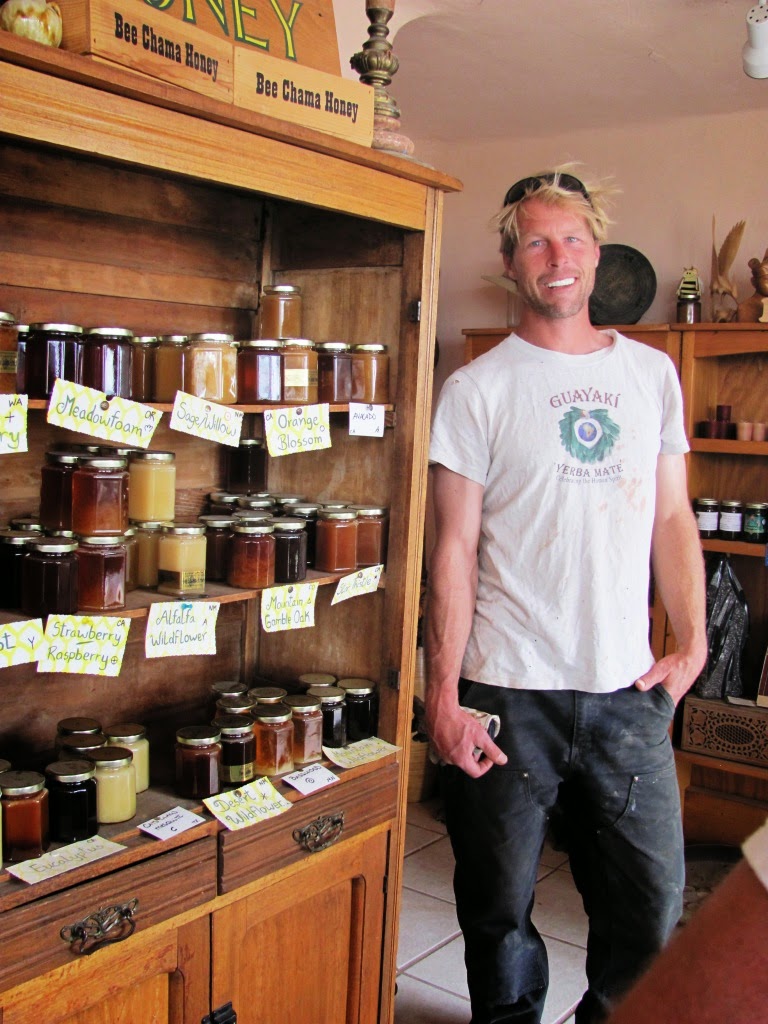
Arik and a variety of honey
Think all honey is the same? A glance at the honey I picked up at Bee Chama Honey shows otherwise. The strawberry/raspberry is a dark amber, the wild blackberry a few shades lighter. The cat’s claw/mesquite is pale, creamy, and opaque. The source of the flower nectar makes the difference. And bees make the honey.

Bee Chama Honey in Polvadera, just off I-25 in central New Mexico, is a sprawling complex of straw bale buildings and animal pens. I stop by with a group of friends after hiking. We cluster around the tasting table, which holds two dozen jars of honey in different flavors. By the time we’re done, everyone has picked at least one type to take home.

“The Middle Rio Grande is good for bees,” says founder Arik Glesne. “We just pay attention to what’s blooming when, and move the bees to control the floral source.” Some of their honey is local, and some of it is traded from other regions, which allows for the wide variety. “We really look for unique flavors.” Arik’s favorite is the mountain gambel oak. The bees use the honeydew off of leaves, instead of nectar from flowers.

Tasting honey
They also sell beeswax and bee pollen. Beeswax, used by the bees to make their honeycombs, can be made into candles. Bee pollen is a traditional medicine said to have many positive effects, including reducing allergies.

Bee Chama Honey has a farm store with observation hives and you-pick salad. They have some sheep for wool and may set up a demonstration loom. They also raise heirloom pigs for meat. They sell in Santa Fe.


Kris Bock writes novels of suspense and romance involving outdoor adventures and Southwestern landscapes. In Counterfeits, stolen Rembrandt paintings bring danger to a small New Mexico town. Whispers in the Dark features archaeology and intrigue among ancient Southwest ruins. What We Found is a mystery with strong romantic elements about a young woman who finds a murder victim in the woods. The Mad Monk’s Treasure follows the hunt for a long-lost treasure in the New Mexico desert. In The Dead Man’s Treasure, estranged relatives compete to reach a buried treasure by following a series of complex clues. Read excerpts at www.krisbock.com or visit her Amazon page.